
Nuclear fusion technology is reconnecting with its origins. While emerging fusion companies continue to pursue the primary objective of supplying electricity to the power grid, a growing number are re-engaging with military and defense uses that initially gave rise to the field.
This industry originated several decades back when researchers sought peaceful applications for the underlying physics of Cold War thermonuclear weapons. The connection to defense has remained steadfast ever since. In fact, a historic fusion energy breakthrough achieved in 2022 took place at the National Ignition Facility, an institution dedicated to defense projects for over a quarter-century.
This pivot has gained momentum as venture capital for climate technology—the main funding stream for fusion ventures—has slowed down. Although fusion firms have secured significant portions of recent climate tech investments, developing fusion remains an exceptionally capital-intensive endeavor, leading venture capitalists to welcome alternative revenue channels for their portfolio companies.
This is where defense contracts step into the spotlight. Military organizations have researched direct-energy laser systems for decades, but enthusiasm has surged recently due to drone warfare altering battlefield dynamics. Legacy anti-air weaponry was engineered to intercept large, rare manned jets, leading to severe economic imbalances during engagements. For instance, around ten years ago, an American partner deployed a $3 million Patriot missile system to destroy an off-the-shelf $200 recreational drone. It worked, but proved completely impractical financially.
Directed-energy laser weapons could completely change that financial equation. Rather than launching costly, single-use interceptors, lasers can engage targets rapidly and economically using power generated onboard by ship engines, reactors, or standard power sources.
Startups engineering laser-driven fusion reactors are uniquely suited to assist in advancing these energy weapons. Recently, laser fusion company Xcimer disclosed a strategic alliance and funding agreement with RTX, the parent organization of defense giant Raytheon. Through this arrangement, Xcimer receives financial backing via RTX Ventures, enabling RTX to evaluate how Xcimer’s high-powered laser tech might benefit military initiatives.
Headquartered in Denver, Xcimer claims to run the world’s most formidable private laser facility, aiming to leverage this setup to engineer a commercial power station. The facility’s design involves hitting fuel pellets with intense laser beams to trigger nuclear fusion and harness the resulting energy. Although their prototype laser system, Phoenix, functions at a fraction of the intensity needed for full-scale energy production, its capabilities have already drawn keen interest from defense contractors.
Xcimer is far from alone in targeting military applications. Pacific Fusion recently inked a cooperative agreement with the National Nuclear Security Administration (NNSA) to conduct joint research on high-energy-density physics.
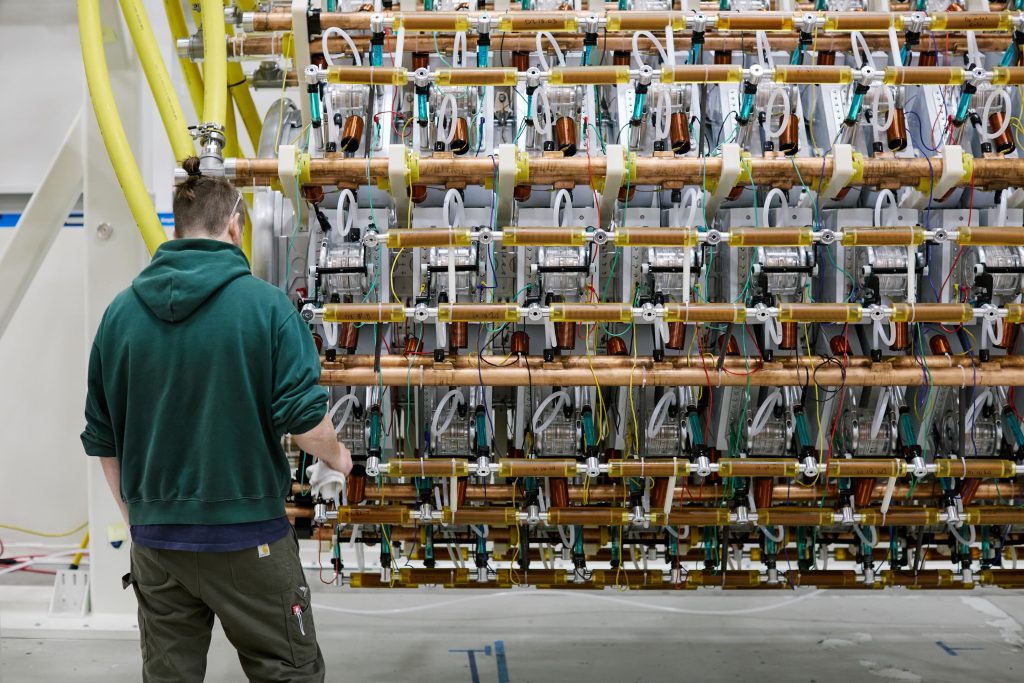
The firm commenced construction on a pilot plant in New Mexico, situated near both Sandia and Los Alamos National Laboratories. Beyond proving that their system can produce net energy gains, the site serves additional objectives. The energy yields generated at Pacific Fusion’s location will exceed the energy levels currently utilized in federal defense testing.
“As it turns out, the infrastructure we are designing offers significant value for top-tier defense programs,” Keith LeChein, co-founder and chief technology officer of Pacific Fusion, shared in a recent interview with TechCrunch.
While this alignment might seem like a fortunate accident, it was entirely intentional. Military uses were “always on our mind,” noted Carrie von Muench, co-founder and chief operating officer at Pacific Fusion. Furthermore, LeChien—who pioneered the firm’s central tech—brings an extensive background from previous roles at Sandia National Laboratories, Lawrence Livermore National Laboratory, and the NNSA.
Fusion technology has evolved dramatically since its inception by mid-century weapons researchers, yet its national security relevance remains intact. Re-aligning with these origins may be a long-awaited shift, offering receptive fusion ventures a powerful new catalyst for growth.